

Blog
What are the Different Types of 3D Printing Methods?

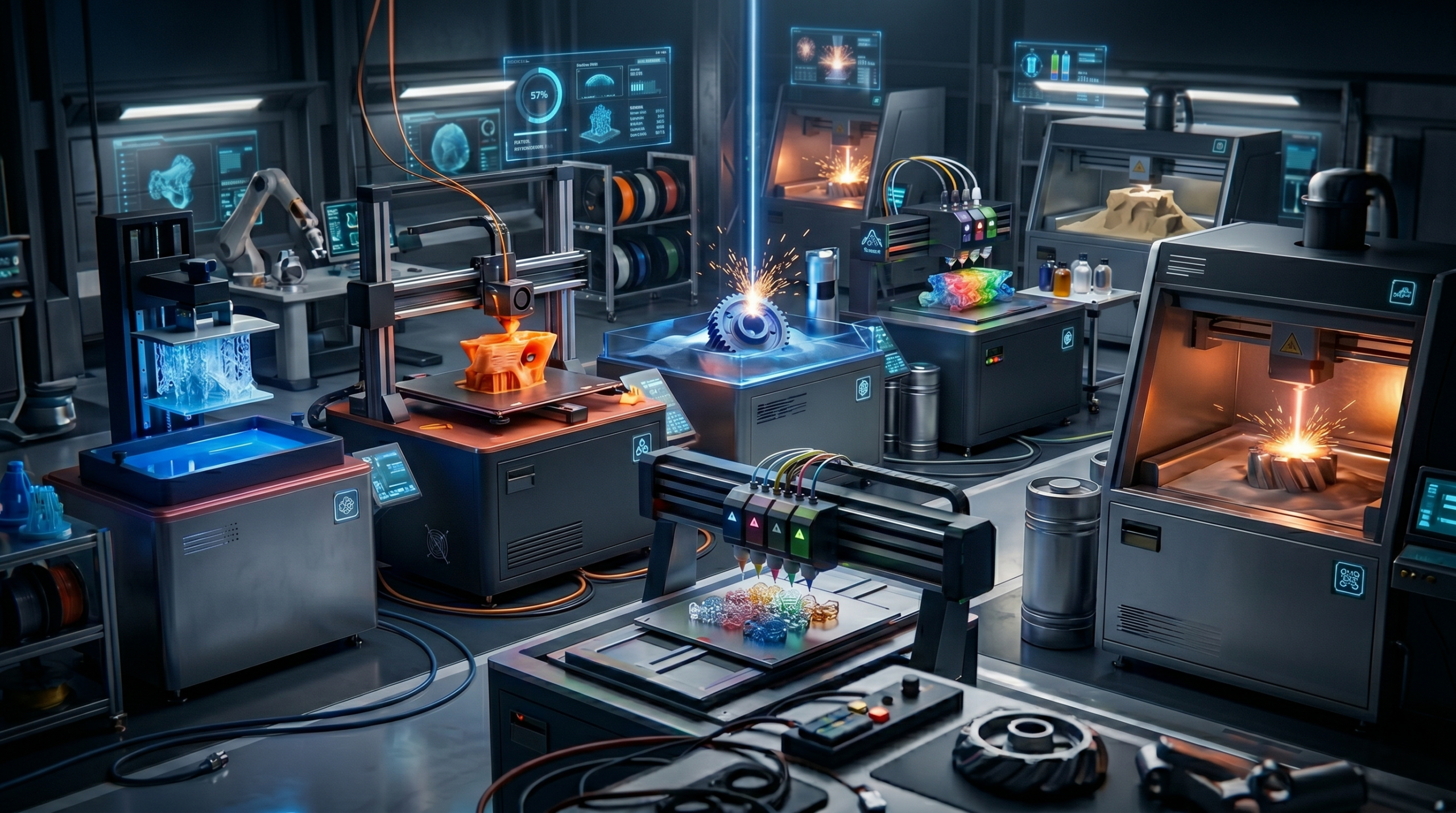
3D printing, also known as additive manufacturing, is a process that builds objects layer by layer instead of subtracting material from a solid block.
Today, different industries use various types of 3D printing methods depending on the material, precision level, and final application. From plastic prototyping to high-strength metal parts, each technology serves a specific purpose.
This guide breaks down the most common 3D printing methods simply and practically.
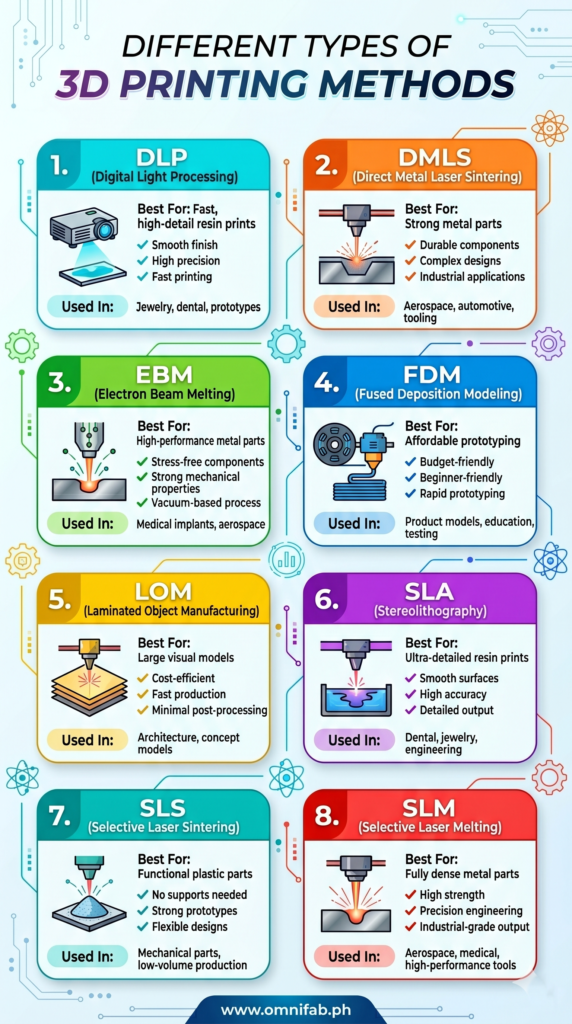
Quick Summary: Different Types of 3D Printing Methods
- FDM (Fused Deposition Modeling) – Best for affordable prototypes and beginner-friendly printing
- SLA (Stereolithography) – Best for smooth, high-detail resin models
- DLP (Digital Light Processing) – Best for fast and precise resin printing
- SLS (Selective Laser Sintering) – Best for strong functional plastic parts
- DMLS (Direct Metal Laser Sintering) – Best for durable industrial metal components
- SLM (Selective Laser Melting) – Best for fully dense, high-strength metal parts
- EBM (Electron Beam Melting) – Best for aerospace and medical-grade metal applications
- LOM (Laminated Object Manufacturing) – Best for large visual prototypes and models
On This Page
- Digital Light Processing (DLP)
- Direct Metal Laser Sintering (DMLS)
- Electron Beam Melting (EBM)
- Fused Deposition Modeling (FDM)
- Laminated Object Manufacturing (LOM)
- Stereolithography (SLA)
- Selective Laser Sintering (SLS)
- Selective Laser Melting (SLM)
- Quick Comparison of 3D Printing Methods
- How to Choose the Right 3D Printing Method
- Types of 3D Printing Methods: Final Thoughts
- FAQs About 3D Printing Methods
1. Digital Light Processing (DLP)
Digital Light Processing (DLP) is a resin-based printing method that uses a light projector to cure liquid photopolymer into solid layers. Unlike other additive manufacturing types, this method prints an entire layer at once, making it significantly faster than laser-based systems.
Key Benefits:
- Fast printing speed
- Smooth surface finish
- High detail output
Common Uses:
- Jewelry design
- Dental models
- Miniatures and prototypes
DLP is often discussed alongside SLA and FDM, especially when comparing precision, speed, and overall printing performance in resin and entry-level 3D printing technologies.
2. Direct Metal Laser Sintering (DMLS)
Direct Metal Laser Sintering (DMLS) is one of the most advanced 3D printing technologies for metal parts. It uses a high-powered laser to fuse metal powder into solid components.
This method is widely used in industries requiring strong and functional parts, such as aerospace and engineering.
Key Benefits:
- Strong metal components
- Complex geometry capability
- High durability
Applications:
- Aerospace parts
- Automotive components
- Industrial tooling
3. Electron Beam Melting (EBM)
Electron Beam Melting (EBM) uses a high-energy electron beam in a vacuum chamber to melt metal powder. This process produces parts with excellent mechanical strength and minimal internal stress.
Key Benefits:
- Stress-free metal parts
- High material integrity
- Ideal for critical applications
Applications:
- Medical implants
- Aerospace structures
- High-performance engineering components
4. Fused Deposition Modeling (FDM)
FDM is the most widely used entry-level method among all types of 3D printing methods. It works by melting thermoplastic filament (such as PLA or ABS) and depositing it layer by layer.
Related: What is Fused Deposition Modeling (FDM) 3D Printing? A Simple Guide
Key Benefits:
- Affordable and accessible
- Easy to use
- Great for rapid prototyping
Common Uses:
- Product prototypes
- Educational models
- Concept testing
5. Laminated Object Manufacturing (LOM)
Laminated Object Manufacturing (LOM) creates objects by stacking and bonding sheets of material such as paper, plastic, or metal. Although less common today, it remains useful for large-scale visual models.
Key Benefits:
- Cost-efficient for large models
- Fast build process
- Minimal post-processing
Applications:
- Architectural models
- Concept visualization
- Presentation prototypes
6. Stereolithography (SLA)
SLA is one of the earliest and most precise additive manufacturing types. It uses a UV laser to cure liquid resin layer by layer. It’s also often evaluated alongside DLP and FDM because of its high precision, smooth surface finish, and ability to produce detailed models.
Related: What is Stereolithography (SLA)? Understanding the Basics of Resin 3D Printing
Key Benefits:
- Extremely high accuracy
- Smooth surface finish
- Ideal for detailed models
Applications:
- Dental and medical models
- Jewelry casting
- Engineering prototypes
7. Selective Laser Sintering (SLS)
SLS uses a laser to sinter powdered materials, typically nylon, into solid structures without the need for support structures.
Related: What is Selective Laser Sintering (SLS) 3D Printing? Understanding Its Basics
Key Benefits:
- No support material required
- Strong functional parts
- High design flexibility
Applications:
- Functional prototypes
- Mechanical parts
- Low-volume production
8. Selective Laser Melting (SLM)
SLM is a high-energy metal printing process that fully melts metal powder into dense, solid parts.
Key Benefits:
- Fully dense metal components
- High strength and precision
- Suitable for critical engineering applications
Applications:
- Aerospace engineering
- Medical implants
- High-performance tools
Quick Comparison of 3D Printing Methods
| Method | Material | Best For | Key Strength |
|---|---|---|---|
| FDM | Plastic | Low-cost prototyping | Affordable & accessible |
| SLA | Resin | High detail models | Smooth finish |
| DLP | Resin | Fast detailed prints | Speed |
| SLS | Powder (nylon) | Functional parts | No supports needed |
| DMLS | Metal | Industrial parts | Strong metal components |
| SLM | Metal | High-performance parts | Fully dense metal |
| EBM | Metal | Aerospace/medical | Stress-free parts |
| LOM | Sheets | Large models | Low cost |
How to Choose the Right 3D Printing Method
1. Material Compatibility
Different methods work with different materials such as plastic filaments, liquid resin, or metal powders. Choose a process that supports the material required for your application.
2. Strength and Durability
Some printing methods are better suited for functional and high-strength parts, while others are designed mainly for visual prototypes and detailed models.
3. Print Quality and Detail
If your project requires smooth surfaces and intricate details, resin-based technologies like SLA or DLP are ideal. For basic prototypes, FDM may be enough.
4. Budget and Production Volume
Entry-level methods like FDM are more affordable for small projects, while industrial metal printing technologies typically involve higher production costs.
5. Application and Purpose
The right method also depends on how the final part will be used—whether for prototyping, product testing, manufacturing, medical use, or engineering applications.
Types of 3D Printing Methods: Final Thoughts
Understanding the different types of 3D printing methods helps you choose the right technology based on your material, budget, precision, and application needs. From FDM for affordable prototyping to SLA, SLS, DMLS, and SLM for advanced manufacturing, each method offers unique advantages for different industries and projects.
FAQs About 3D Printing Methods
What is the most common 3D printing method?
FDM (Fused Deposition Modeling) is the most widely used due to its affordability and accessibility.
What is the most accurate 3D printing method?
SLA and DLP offer the highest detail and smooth surface finishes.
What is the strongest 3D printing method?
Metal-based methods like SLM, DMLS, and EBM produce the strongest parts.
Is 3D printing expensive?
It depends on the method—FDM is low-cost, while metal printing methods are more expensive due to materials and equipment.
Looking for reliable results? Explore professional 3D printing services in the Philippines for prototyping and manufacturing to bring your ideas to life with precision and speed.
Last Updated: May 18, 2026
First Published: February 28, 2022