


Blog
PLA vs. ABS: Which 3D Printing Filament is Best for Beginners?

If you’ve just started exploring the world of 3D printing, you’ve probably come across two of the most common 3D printing filaments — PLA and ABS. Both are popular, both have their pros and cons, and both are widely used in 3D printing for beginners and professionals alike.
But when you’re new to the craft, figuring out the difference between PLA vs ABS filament can get confusing. Which one gives better results? Which is easier to work with? And most importantly — which one should you start with?
Let’s break it down in plain language so you can decide which 3D printing filament fits your needs best.
On This Page
- What Is PLA Filament?
- What Is ABS Filament?
- PLA vs. ABS 3D Printing: Key Differences
- Which One Should You Choose: PLA or ABS Filament?
- Frequently Asked Questions (FAQs) About PLA and ABS Filament for 3D Printing
- Final Thoughts: PLA vs. ABS 3D Printing for Beginners
What Is PLA Filament?
PLA, or Polylactic Acid, is a biodegradable plastic made from renewable sources like cornstarch or sugarcane, which makes it the “eco-friendly” choice.
In PLA 3D printing, the material is easy to use, produces smooth results, and gives off only a light, sweet smell often compared to corn or maple syrup. While it’s milder than ABS, it still emits small amounts of volatile organic compounds (VOCs) and fine particles, so good ventilation is recommended.
It’s a top pick for beginners since it prints well at lower temperatures and doesn’t need special equipment.
You’ll often find PLA filament used for:
- Decorative models
- Prototypes and toys
- Cosplay props
- Educational projects
What Is ABS Filament?
ABS, short for Acrylonitrile Butadiene Styrene, is a petroleum-based plastic — the same material used to make LEGO bricks. It’s tougher, more heat-resistant, and overall more durable than PLA.
When printing with ABS filament, though, you’ll need a higher temperature and a heated bed to prevent warping. ABS also emits a noticeable smell while printing, so it’s best used in a well-ventilated area or an enclosed printer.
ABS filament for 3D printing is great for:
- Functional parts and tools
- Car parts or mechanical components
- High-strength prototypes
- Products that need to resist heat or stress
PLA vs. ABS 3D Printing: Key Differences
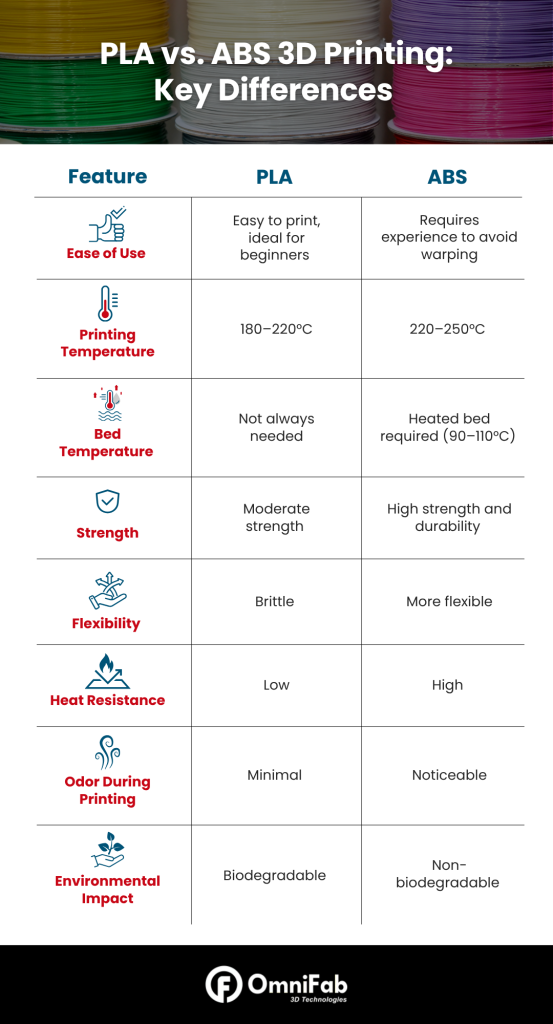
To make it easier, here’s a quick 3D printing filament comparison that breaks down how PLA and ABS perform in key areas:
Now let’s unpack these points so you can see what really matters depending on what you want to create.
1. Ease of Printing
If you’re still figuring out how 3D printers work, PLA is the best filament for beginners. It’s forgiving — you don’t need a heated bed or perfect settings to get decent prints.
- PLA adheres well to most print beds, rarely warps, and can produce clean, detailed results even at lower temperatures. You can load it up, hit print, and get a good outcome with minimal fuss.
- ABS, on the other hand, can be a little temperamental. It’s sensitive to temperature changes, so it might curl up at the edges or detach from the bed if your setup isn’t dialed in.
2. Durability and Strength: ABS Holds Up Better
When it comes to strength and durability, ABS filament clearly takes the lead. It’s more impact-resistant and can handle higher temperatures, making it ideal for printing mechanical parts or items that will face wear and tear.
PLA, while solid enough for decorative or light-duty prints, can become brittle over time — especially in warm environments. Leave a PLA model in a hot car, and you might see it soften or deform.
So if you’re printing functional components or parts that need to withstand heat and pressure, ABS is the better option.
3. Print Quality and Finish: Depends on What You Want
Both materials can produce high-quality prints, but they shine in different ways.
- PLA prints tend to have a smoother and glossier finish straight off the printer. You can also find it in a wide variety of colors and special blends — like silk, matte, or even wood-fill PLA.
- ABS prints, on the other hand, have a slightly matte, industrial look. The cool part is that ABS can be post-processed using acetone vapor to achieve a sleek, glossy finish — perfect if you want a professional, polished look.
If aesthetics matter more to you, PLA is easier to make look good right away. But if you want to experiment with post-processing, ABS offers more flexibility.
4. Environmental Impact: PLA Is More Sustainable
If sustainability is part of your decision-making, PLA filament gets another point. Being plant-based and biodegradable, it’s less harmful to the environment than ABS, which is petroleum-derived and not biodegradable.
However, note that PLA doesn’t break down easily in normal conditions — it still requires industrial composting facilities. Still, between the two, PLA is definitely the greener option.
5. Price and Availability: Almost a Tie
In terms of cost, both PLA and ABS filaments are widely available and similarly priced. You can find affordable options for both in local 3D printing stores and online marketplaces.
That said, PLA is often a bit cheaper and more accessible to beginners since it’s so commonly used. You’ll find more PLA brands, colors, and specialty blends on the market.
6. Safety and Odor: PLA Is Easier on the Senses
If you’re printing in your bedroom or home office, PLA wins again. It produces little to no odor, making it much more pleasant for indoor use.
ABS emits fumes that can be irritating if you’re printing in a small, enclosed space without proper ventilation. A well-ventilated or enclosed printer setup is a must for ABS 3D printing.
Which One Should You Choose: PLA or ABS Filament?
When deciding between PLA vs ABS filament, it all comes down to your goals and experience level.
- Choose PLA filament if you’re new to 3D printing and want a smooth, hassle-free start. It’s the best filament for beginners because it’s easy to handle, works well without a heated bed, and delivers clean, detailed prints that look great right off the printer.
- Choose ABS filament if you need strong, heat-resistant parts that can handle stress or outdoor conditions. It takes a bit more setup — like maintaining the right temperature and ventilation — but the results are worth it for functional or industrial-grade projects.
In short, for beginners, PLA is the better starting point. It lets you focus on learning the basics of 3D printing without the extra challenges that come with ABS.
Once you get the hang of it and want to experiment with tougher materials, then moving to ABS filament for 3D printing makes sense.
Frequently Asked Questions (FAQs) About PLA and ABS Filament for 3D Printing
1. Which is better for beginners — PLA or ABS filament?
PLA filament is generally the best choice for beginners because it’s easy to print, doesn’t require a heated bed, and delivers smooth, detailed results. ABS offers more strength and heat resistance but needs higher temperatures and careful temperature control to avoid warping.
2. Is PLA filament safe to use indoors?
Yes. PLA is one of the safest filaments for indoor 3D printing. It gives off a mild, sweet odor (similar to corn syrup) and emits fewer fumes than ABS. However, like any plastic, it can still release small amounts of VOCs and fine particles, so printing in a well-ventilated space is recommended.
3. Can I use PLA and ABS on the same 3D printer?
Yes, most FDM 3D printers can handle both PLA and ABS filaments. Just remember that ABS requires a heated bed and a more enclosed environment to prevent warping, while PLA prints easily on open-frame setups.
4. What are the main differences between PLA and ABS filament?
PLA is biodegradable, easy to print, and great for decorative or beginner projects. ABS, on the other hand, is more durable, heat-resistant, and suitable for functional or industrial-grade parts. The choice depends on your project’s purpose and environment.
5. Which 3D printing filament is more durable — PLA or ABS?
ABS is more impact-resistant and can withstand higher temperatures, making it better for parts that need to endure stress, heat, or outdoor conditions. PLA is less durable but ideal for visual models, prototypes, and hobby projects.
Final Thoughts: PLA vs. ABS 3D Printing for Beginners
When comparing PLA and ABS filament, it’s really about your goals as a maker. PLA offers simplicity and great visual results, ideal for anyone just getting started. ABS provides toughness and heat resistance, making it more suitable for advanced projects once you’ve mastered the basics.
If you’re still unsure, try both. The best way to understand 3D printing filament comparison is to print, test, and see what works for you.
Turn your ideas into reality. Start your first 3D printing project in the Philippines and see how the right filament choice can make all the difference.