

Blog
3D Printed Houses vs.Traditional Homes: Pros, Cons, and Major Differences


The idea of building homes using a giant 3D printer might’ve sounded impossible a few years ago, but not anymore. Across the world (and even in the Philippines), 3D printed houses are becoming a hot topic among architects, engineers, and future homeowners.
But how exactly do 3D printed homes compare to traditional houses? Are they cheaper, faster, and better, or just another tech trend? Let’s break down the pros, cons, and key differences to help you decide which one makes more sense for your dream home.
On This Page
- What is a 3D Printed House?
- How Traditional Homes are Built
- 3D Printed Houses vs. Traditional Homes: Pros and Cons
- 3D Printed Houses vs Traditional Houses: Major Differences
- FAQs About 3D Printed Houses
- Are 3D Printed Houses the Future of Construction?
What is a 3D Printed House?
A 3D printed house is exactly what it sounds like: a house built using a 3D printer. Instead of manually laying bricks or pouring concrete, a massive printer extrudes layers of specialized concrete or composite material to “print” the walls and structure.
This process is known as 3D printed house construction, and it’s controlled by a computer that follows a digital blueprint. Think of it as printing a model on your desktop printer, only this one builds an actual house, layer by layer.
In the Philippines, 3D printed houses are slowly gaining attention as a faster and more sustainable alternative to traditional construction. Some innovators are already exploring how this technology could help solve housing shortages and build affordable, disaster-resilient homes.
How Traditional Homes are Built
In contrast, traditional houses are constructed using familiar methods such as manual labor, cement mixing, bricklaying, and wooden or steel framing. This approach has been around for centuries and relies heavily on skilled workers, weather conditions, and longer timelines. While conventional home building is tried and tested, it can be time-consuming and expensive due to labor costs, material waste, and delays caused by weather or supply issues.
3D Printed Houses vs. Traditional Homes: Pros and Cons
Both 3D printed houses and traditional homes have their strengths and weaknesses. The best choice really depends on your priorities, whether it’s speed, cost, durability, or sustainability. Here’s a clear and straightforward comparison to help you decide.
3D Printed House Pros and Cons
Pros
- Faster construction: A 3D printed house can be built in a matter of days instead of several months, making it ideal for rapid housing or post-disaster rebuilding.
- Lower labor costs: Since much of the work is automated, you’ll need fewer workers on-site, cutting down overall expenses.
- Less material waste: The printer uses precise amounts of concrete, which reduces excess and makes the process more sustainable.
- Creative design freedom: You can easily print modern, curved, or futuristic layouts that would cost more using traditional methods.
- Eco-friendly option: Many 3D printed homes use sustainable or recyclable materials and consume less energy during construction.
Related: Sustainability and 3D Printed Houses: A Greener Way to Build
Cons
- Limited availability in the Philippines: The technology for 3D printed house construction in the Philippines is still developing and not widely accessible yet.
- High initial investment: The printer setup and materials can be expensive for first-time adopters.
- Regulatory challenges: There are still few local laws or building codes that cover 3D printed housing standards.
- Manual finishing still needed: Plumbing, roofing, wiring, and other finishing tasks must be done by hand after printing the structure.
Traditional House Pros and Cons
Pros
- Proven durability: Traditional homes have stood the test of time. When built properly, they can last for decades or even generations.
- Readily available materials: Cement, wood, and steel are easy to source locally, making construction straightforward.
- Easier financing and permits: Banks, insurance companies, and local agencies are already familiar with conventional housing standards.
- Wide range of skilled workers: Builders, carpenters, and electricians are trained and experienced in this method, ensuring consistent quality.
Cons
- Longer build time: Traditional homes often take months (or even years) to finish, especially if there are delays due to labor or weather.
- Higher labor and material costs: Manual work and material waste can drive up the overall cost.
- Less design flexibility: Unique or complex designs can be time-consuming and more expensive to build.
- Environmental impact: Conventional construction produces more waste and uses more resources compared to 3D printing
3D Printed Houses vs Traditional Houses: Major Differences
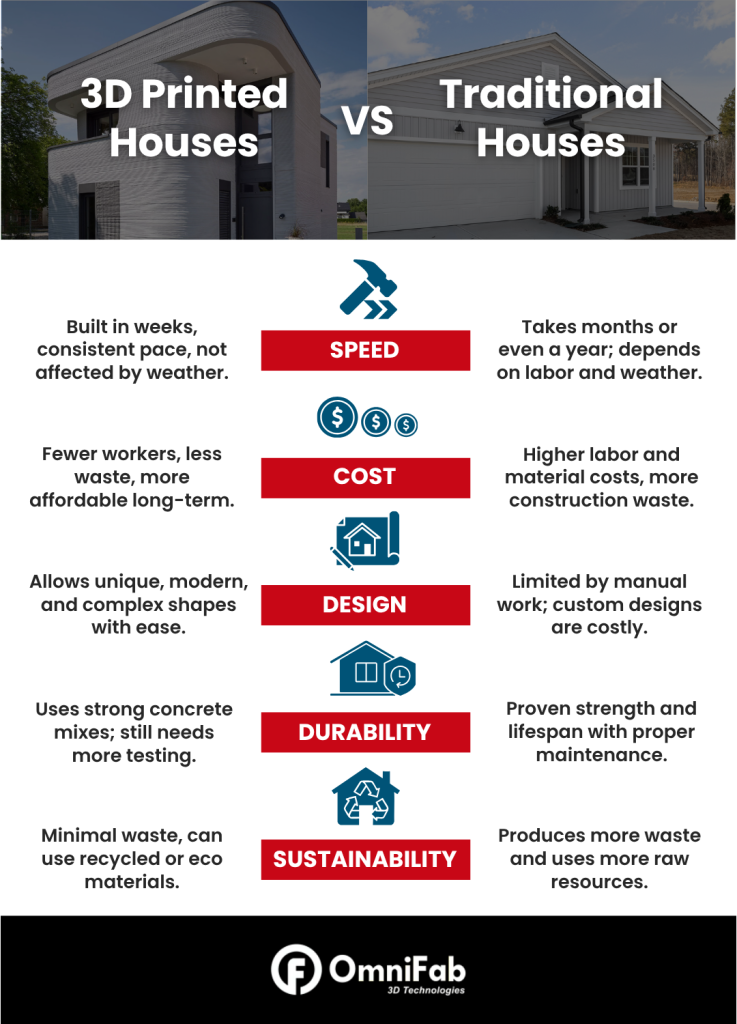
Here’s where things get interesting. When comparing 3D printed houses and traditional houses, you’ll see that they differ not only in process but also in cost, sustainability, and design flexibility.
1. Construction Speed
One of the biggest advantages of a 3D printed home is speed. A small 3D printed house can be completed in just a few days, while a traditional home might take several months or even a year.
Related: 3D Printing in Construction: The Advantages and Disadvantages
Because the printer works continuously and doesn’t depend on manual labor or perfect weather, the timeline is much more predictable. In the Philippines, where some regions are often hit by natural disasters, this technology could help rebuild homes faster and more efficiently.
2. Cost Efficiency
When it comes to cost, the comparison between 3D printed houses vs traditional houses shows that 3D printing can be more affordable in the long run. Since fewer workers are needed and there’s less material waste, overall expenses are reduced. That said, the 3D printed house cost depends on local material availability, printer setup, and design complexity.
3. Design Flexibility
Another clear win for 3D printing is creative freedom. The technology allows architects to design curves, angles, and custom structures that would be expensive or impossible to build using traditional methods.
If you want a futuristic or unique layout, 3D printed homes make it easier to bring that vision to life without increasing costs significantly.
4. Durability and Strength
A common question people ask is: Are 3D printed houses durable?
The answer is — yes, but it depends on the materials used and how they’re reinforced. Most 3D printed homes are made of concrete mixes designed to withstand harsh conditions, but they still require testing and certifications to meet building standards.
Traditional houses, on the other hand, have a proven track record. With proper maintenance, they can last for decades or even generations. So, if long-term durability is your top priority, traditional construction still holds the upper hand — for now.
5. Environmental Impact
This is where 3D printed homes really shine. Traditional construction generates tons of waste, from excess cement to leftover materials. 3D printing minimizes this by using only what’s needed.
Plus, some companies are experimenting with eco-friendly materials such as recycled plastic or biodegradable compounds to make the process greener. This makes 3D printed houses an appealing choice for sustainable living advocates.
FAQs About 3D Printed Houses
1. How long does it take to build a 3D printed house?
Depending on the complexity of size and design, a 3D printed house can be completed in as little as 24 hours to a few weeks. Finishing touches like electrical wiring and plumbing might take additional time.
2. Are 3D printed houses cheaper than traditional homes?
Generally, yes. 3D printed homes are more cost-efficient because they use fewer materials and less labor. However, the 3D printed house cost in the Philippines might still be higher due to limited local technology and materials.
3. Are 3D printed houses durable?
Absolutely. Most 3D printed houses are built using high-strength concrete that can withstand weather and wear. Still, proper testing and local compliance are needed to ensure long-term safety and durability.
4. Can I build a 3D printed house in the Philippines?
Not yet on a wide scale, but some startups and researchers are exploring 3D printed house construction in the Philippines. It’s expected to grow as the technology becomes more affordable and government regulations adapt.
5. Are 3D printed homes eco-friendly?
Yes. 3D printing minimizes waste and uses only the exact amount of materials needed. Some projects even use recycled or low-carbon materials, making 3D printed homes a greener choice compared to traditional building methods.
6. Will 3D printed homes replace traditional houses?
Not anytime soon, but they’ll definitely complement them. As technology improves, 3D printed houses vs traditional houses won’t be a competition but a partnership, combining innovation with proven techniques.
Are 3D Printed Houses the Future of Construction?
The global construction industry is evolving, and 3D printed homes are leading that change. From cost savings to sustainability, the benefits are too significant to ignore.
Countries like the U.S., Japan, and the Netherlands are already experimenting with entire communities built using advanced technology. In fact, a housing breakthrough in the Netherlands proved that this innovation is no longer just an idea—it’s already shaping real neighborhoods.
It’s only a matter of time before the 3D printed house in the Philippines becomes a reality too. With rising housing demand and frequent natural disasters, the potential for this technology to provide affordable, quick, and durable homes is enormous.
Looking for a greener way to build your dream home? Start building your own 3D printed house in the Philippines today.