

Blog
Pellet 3D Printer vs. Filament 3D Printer: Key Differences Explained

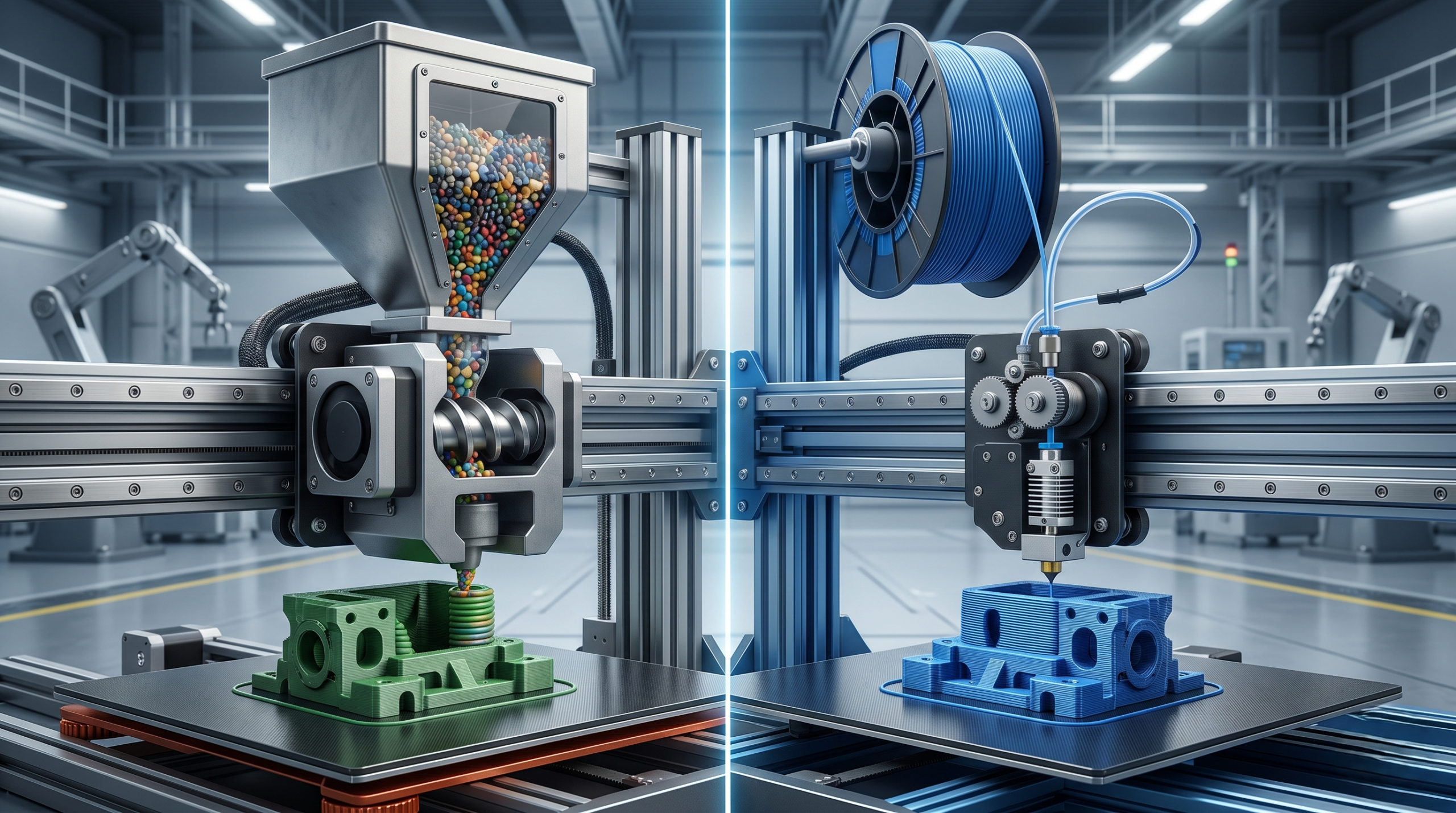
Not all 3D printers are built the same, and if you’re stuck choosing between pellet and filament, it can get confusing fast. The debate around pellet 3D printers and filament 3D printers usually comes down to one thing: what exactly are you trying to produce?
From material costs and print speed to scalability and overall output quality, each option brings its own advantages—and knowing these differences can save you time, money, and a lot of trial and error.
Quick Summary: Pellet 3D Printer vs. Filament 3D Printer
In short: Choose a Filament 3D Printer (FDM) for high-detail, small-to-medium prototypes and beginner-friendly projects. Choose a Pellet 3D Printer (FGF) for large-scale industrial parts, high-volume production, and to reduce material costs by up to 70–90%.
On This Page
- Key Differences at a Glance
- What is a Pellet 3D Printer?
- What is a Filament 3D Printer?
- Pellet 3D Printer vs. Filament 3D Printer: What are the differences?
- Pellet vs. Filament 3D Printers: When to Choose Each
- Pros and Cons of Pellet vs. Filament 3D Printers
- Final Thoughts: Choosing the Right 3D Printer
- FAQ: Common Questions
Key Differences at a Glance
| FEATURE | FILAMENT 3D PRINTER | PELLET 3D PRINTER |
|---|---|---|
| Raw Material | Spooled Filament (Processed) | Plastic Pellets (Raw) |
| Material Cost | High | Low |
| Print Speed | Slower (Detail-oriented) | Fast (Volume-oriented) |
| Best For | Hobbyists, Schools, Detailed Parts | Manufacturing, Furniture, Large Prototypes |
| Scalability | Limited by Spool Size | High (Industrial Bulk) |
What is a Pellet 3D Printer?
A pellet 3D printer uses raw plastic pellets instead of filament. These pellets are the same materials used in traditional plastic manufacturing processes like injection molding.
Related: What is a Pellet 3D Printer? A Beginner’s Guide to Large-Scale 3D Printing
Why Industries are Shifting to Pellets:
- Significant Cost Savings: By skipping the process of turning plastic into filament, material costs drop drastically.
- Faster Output: Pellet extruders can deposit pounds of plastic per hour, whereas filament is limited by the diameter of the wire.
- Sustainability: You can often use recycled regrind or custom material blends that aren’t available in filament form.
- Industrial Presence: In regions like the Philippines, pellet 3D printer options are increasingly popular for large-scale fabrication and furniture design.
What is a Filament 3D Printer?
A filament 3D printer is the most common type you’ll see today. It uses spools of plastic filament PLA or ABS, which are melted and extruded through a nozzle to create objects layer by layer.
Related: What is a 3D Printing Filament? A Beginner’s Guide
Why Filament Remains the Gold Standard for Hobbyists:
- User-Friendly: It is essentially “plug-and-play.”
- High Precision: The small nozzle diameters allow for intricate geometric details.
- Availability: Spools are easy to store, transport, and buy in small quantities.
Pellet 3D Printer vs. Filament 3D Printer: What are the differences?
Let’s get into the real comparison. Here’s a clear breakdown of the filament vs pellet 3D printer differences that actually matter.
1. Material Cost
One of the biggest differences comes down to cost.
- Filament printers use pre-processed materials, which are more expensive.
- Pellet printers use raw plastic, which can be significantly cheaper.
If you’re printing in high volumes, this adds up quickly. It’s also why many people ask: “is pellet 3D printing cheaper than filament?”—and in most large-scale cases, the answer is yes.
For businesses, this makes pellet systems more cost-efficient in the long run.
2. Print Speed
Speed isn’t just about how fast the nozzle moves—it’s about how much material is being deposited.
- Filament printers are slower and more precise
- Pellet printers extrude more material at once, making them faster for large prints
If your goal is production, not just prototyping, pellet printers have a clear advantage.
3. Print Size and Application
Here’s where the difference becomes really obvious:
- Filament printers = small to medium-sized objects
- Pellet printers = large-scale parts and prototypes
Pellet systems are often used for furniture, automotive parts, and industrial components. Meanwhile, filament printers shine when it comes to detailed models or smaller functional parts.
4. Print Quality and Precision
Filament printers are known for cleaner finishes and finer details.
- Filament → smoother surfaces, higher precision
- Pellet → rougher finish, but improving with new tech
So if you’re focused on aesthetics or intricate designs, filament still wins here.
5. Material Variety
Both options support a wide range of materials, but in different ways:
- Filament printers offer ready-to-use specialty filaments (flexible, wood-fill, etc.)
- Pellet printers allow direct use of industrial-grade and recycled plastics
This makes pellet systems more flexible for manufacturing, especially if sustainability is part of your goals.
Pellet vs. Filament 3D Printers: When to Choose Each
Understanding the differences between pellet and filament 3D printers helps you pick the right one for your needs. Here’s a quick guide:
Consider a pellet 3D printer if:
- You’re producing large parts or high-volume prints
- Reducing material costs is a priority
- You’re operating in manufacturing or industrial settings
- You need faster output for bulk production
Consider a filament 3D printer if:
- You’re just getting started with 3D printing
- High-detail or small-scale prints are your main focus
- You want a user-friendly, plug-and-play system
- You’re working on prototypes or creative projects
Pros and Cons of Pellet vs. Filament 3D Printers
Pellet 3D Printer
Pros
- Lower material cost for bulk printing
- Faster for large builds
- Suitable for industrial and manufacturing use
Cons
- Higher upfront investment
- Requires more technical expertise
- Surface finish may be rougher than filament prints
Filament 3D Printer
Pros
- Easy to use and beginner-friendly
- Affordable for small-scale printing
- High precision and detailed output
Cons
- Material costs can be higher
- Slower for larger prints
- Not ideal for industrial-scale production
Final Thoughts: Choosing the Right 3D Printer
At the end of the day, the choice between pellet and filament comes down to your goals.
If you’re just getting into 3D printing or focusing on detailed, smaller outputs, filament is still the most practical choice. But if you’re aiming for efficiency, scalability, and long-term savings, pellet systems are worth considering.
As the industry continues to grow, more businesses, especially those in manufacturing, are exploring pellet-based solutions. With the increasing interest in pellet and filament 3D printing, it is clear that both technologies have their place.
FAQ: Common Questions
Q: Can I use recycled plastic in a pellet 3D printer?
A: Yes. One of the primary advantages of pellet printers is their ability to use shredded recycled plastic (regrind), making them much more sustainable than filament systems.
Q: Are pellet 3D printers harder to use?
A: Generally, yes. They require more technical knowledge regarding heat zones and extrusion pressure compared to the “set it and forget it” nature of desktop filament printers.
Q: Where can I buy a pellet 3D printer in the Philippines?
A: Industrial-grade pellet systems are available through trusted local distributors.
Looking to start large-scale 3D printing? Find out where to buy pellet 3D printers in the Philippines and contact us for expert guidance.