

Blog
How Fab Labs Promote Sustainable and Circular Manufacturing

Sustainability has become an operational necessity across global industries. Businesses and creators continuously seek smarter ways to reduce waste, conserve resources, and streamline production. One approach gaining rapid global momentum is the integration of fab labs and sustainable manufacturing practices.
These open-access innovation spaces equip entrepreneurs, students, engineers, and researchers with advanced digital fabrication tools. By democratizing access to modern technology, fab labs make product development faster, more resource-efficient, and directly aligned with circular economy principles.
Unlike traditional linear manufacturing—which relies on high-volume mass production and generates substantial material scrap—Fab Labs prioritize rapid prototyping, localized production, repairability, and iterative design. Whether supporting grassroots startups or established industrial players, these facilities serve as vital engines for green innovation worldwide, including the expanding network of digital fabrication hubs across the Philippines.
Quick Summary: How Fab Labs Support Sustainable Manufacturing
Fab labs and sustainable manufacturing work together to reduce waste, improve resource efficiency, and support circular manufacturing through digital fabrication technologies. By using tools like 3D printers, laser cutters, and CNC machines, Fab Labs enable rapid prototyping, localized production, product repair, and on-demand manufacturing. These practices help businesses lower material consumption, reduce carbon emissions, and create products more sustainably.
Key Takeaways:
- Fab labs reduce material waste through rapid prototyping and additive manufacturing.
- Digital fabrication supports circular manufacturing by making products easier to repair, redesign, and reuse.
- Localized production shortens supply chains and helps lower transportation-related carbon emissions.
- 3D printing enables on-demand manufacturing, reducing excess inventory and overproduction.
- Fab labs make advanced manufacturing technologies more accessible to startups, educators, researchers, and manufacturers.
- The growing network of fab labs in the Philippines is driving innovation, strengthening local manufacturing, and supporting sustainable product development.
On This Page
- What is a Fab Lab?
- How Fab Labs Support Sustainable Manufacturing
- Encouraging Local Manufacturing
- Making Product Development More Sustainable
- Making Advanced Manufacturing More Accessible
- The Role of 3D Printing in Sustainable Manufacturing
- How Fab Labs Help Build a Circular Economy
- Fab Labs in the Philippines are Driving Local Innovation
- Conclusion: Why Fab Labs and Sustainable Manufacturing Matter
- Frequently Asked Questions About Fab Labs and Sustainable Manufacturing
What is a Fab Lab?
A Fabrication Laboratory, commonly known as a fab lab, is a collaborative workspace equipped with digital fabrication technologies such as:
- 3D printers
- Laser cutters
- CNC machines
- Vinyl cutters
- Electronics workstations
- Design and prototyping software
These facilities allow users to transform digital designs into functional prototypes or finished products without investing in expensive industrial equipment. Beyond providing access to technology, fab labs encourage collaboration, experimentation, and knowledge sharing, making them valuable environments for innovation and sustainable product development.
Related: What is a Fab Lab? A Beginner’s Guide to Digital Fabrication Spaces
How Fab Labs Support Sustainable Manufacturing
The connection between fab labs and sustainable manufacturing lies in their ability to help businesses produce smarter instead of producing more. Rather than relying on lengthy production cycles and excessive material consumption, digital fabrication focuses on efficiency throughout the design and manufacturing process.
Reducing Material Waste Through Rapid Prototyping
Conventional product design requires multi-stage tooling and subtractive machining, where large blocks of raw material are milled away, leaving up to 40% to 70% of input materials as scrap.
Fab labs mitigate this inefficiency through rapid iterative prototyping. Using additive techniques like 3D printing, material is deposited strictly where required by the digital CAD file.
This results in several key benefits:
- Less material waste
- Lower development costs
- Faster design improvements
- More efficient use of resources
Supporting Circular Manufacturing
Circular manufacturing focuses on keeping products, components, and raw materials at their highest utility and value at all times. Fab labs actively operationalize circularity by enabling digital repair ecosystems.
When a single component of a commercial machine or household appliance breaks, the entire product is often discarded due to unavailable spare parts. In a fab lab, technicians can reverse-engineer broken components, modify the CAD file, and manufacture a precise functional replacement locally. This extends total product lifespans while diverting electronic and structural waste from landfills.
Encouraging Local Manufacturing
Global supply chains have a significant environmental impact, with freight transportation responsible for about 8% to 10% of global greenhouse gas emissions. One way to reduce this impact is through distributed manufacturing, where products are designed digitally and manufactured closer to where they are needed.
Fab labs enable this by providing local access to digital fabrication technologies. As more fab labs open across the Philippines and Southeast Asia, businesses and communities can produce products on demand near the end user. This reduces the need for long-distance shipping, shortens delivery times, and helps lower carbon emissions.
Key Environmental & Operational Benefits
- Lower Shipping Pollution: Making products locally cuts down on long-distance delivery trips by trucks, ships, and planes. This significantly reduces Scope 3 emissions, which include transportation-related greenhouse gas emissions across the supply chain.
- No Wasted Products or Storage: Products are only made when someone actually orders them. This prevents overproduction and eliminates the need for big, expensive warehouses to store unsold items.
- Fewer Supply Delays: Local production protects businesses from global shipping delays and supply shortages, making sure products are always available when needed.
Making Product Development More Sustainable
Creating a successful product usually involves multiple rounds of testing and refinement. With traditional manufacturing, every design revision can require new tooling, additional materials, and increased production costs.
Fab labs simplify this process through digital fabrication. Designers can quickly create prototypes, gather feedback, and improve their products before moving into full-scale production. This iterative approach reduces unnecessary waste while helping businesses launch higher-quality products.
Better Design Leads to Less Waste
Products that are carefully designed often last longer, perform better, and require fewer replacements over time. Fab labs encourage continuous improvement by giving innovators the freedom to test new ideas without the financial risks associated with traditional manufacturing. The result is a more efficient design process that supports long-term sustainability.
Making Advanced Manufacturing More Accessible
Sustainable manufacturing should not be limited to large corporations with extensive resources. Fab labs help level the playing field by giving startups, educational institutions, researchers, local manufacturers, and small businesses access to advanced fabrication equipment through shared workspaces.
This accessibility allows more organizations to explore digital fabrication, develop innovative products, and adopt sustainable manufacturing practices without making significant investments in expensive machinery.
The Role of 3D Printing in Sustainable Manufacturing
Among today’s digital fabrication technologies, 3D printing plays a major role in advancing sustainable manufacturing. Because objects are built layer by layer, only the necessary material is used, helping reduce waste compared to many conventional production methods.
Beyond improving material efficiency, the technology also enables lightweight product designs, rapid prototyping, on-demand manufacturing, and localized production. As 3D printing adoption continues to grow, more businesses are discovering how additive manufacturing can shorten development cycles while supporting more responsible production practices.
How Fab Labs Help Build a Circular Economy
A circular economy focuses on extending the life of products and minimizing waste throughout the manufacturing process. Fab labs support these goals by encouraging smarter design, localized production, and responsible resource management.
Design for Longevity
Fab labs encourage products to be designed with durability, repairability, and modular components in mind. These design principles help extend product lifespans and reduce the need for frequent replacements.
Repair Instead of Replace
When products break, replacement parts can often be produced locally using digital fabrication technologies. This allows businesses and consumers to repair products instead of discarding them, reducing unnecessary waste.
Reuse Existing Materials
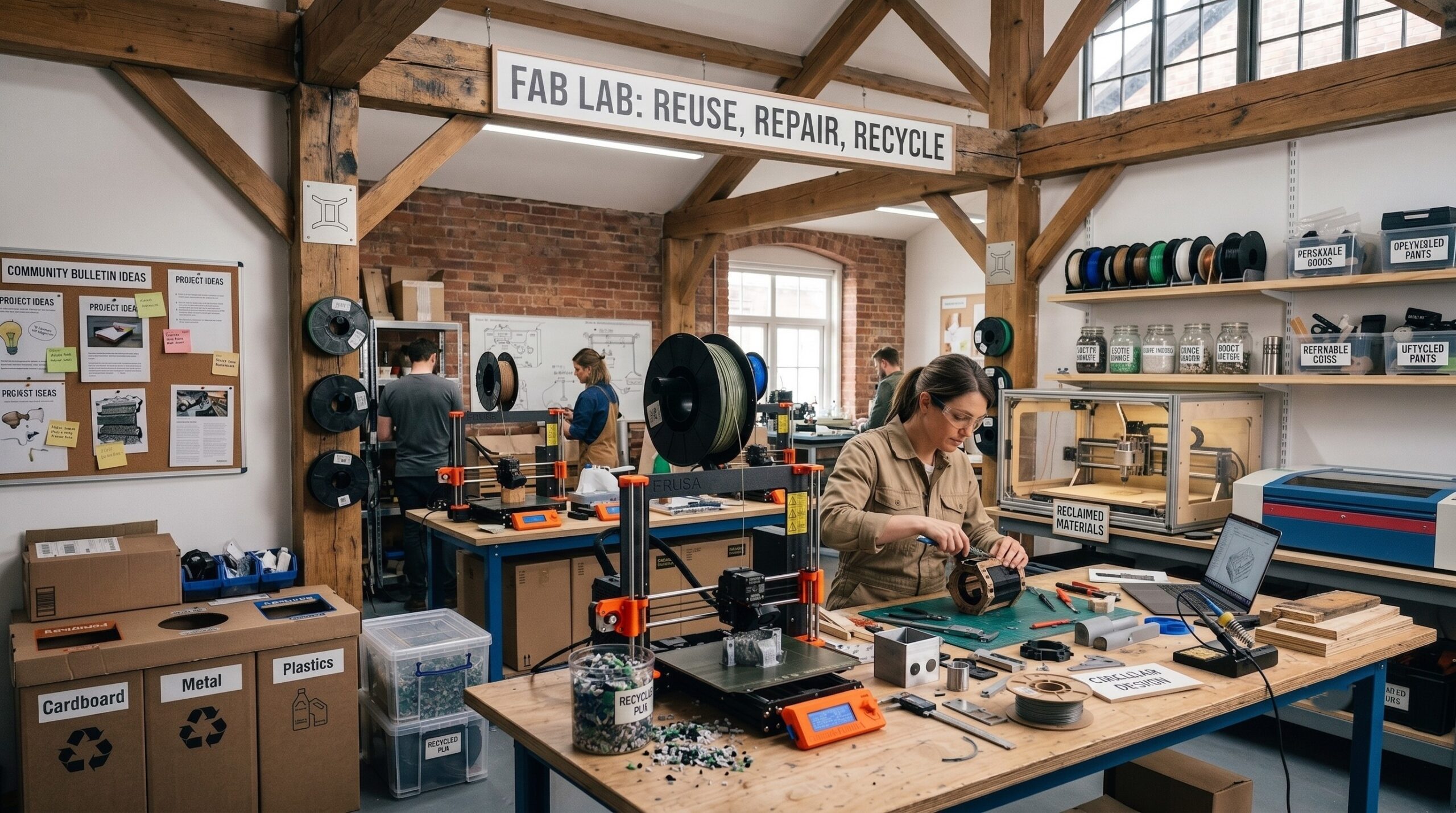
Many fab labs explore the use of recycled plastics and reclaimed materials during prototype development. Reusing existing resources helps lower demand for new raw materials while supporting more environmentally responsible manufacturing.
Manufacture Only When Needed
On-demand manufacturing allows products to be created only when there is actual demand. This approach helps reduce overproduction, minimizes excess inventory, and improves overall resource efficiency.
Together, these practices demonstrate how Fab Labs support sustainable manufacturing while helping businesses adopt more circular production strategies.
Fab Labs in the Philippines are Driving Local Innovation
In the Philippines, the expansion of Fab Labs—supported by academic institutions, the Department of Trade and Industry (DTI), and private innovation networks—is democratizing industrial technology. These local facilities serve as incubator spaces for eco-entrepreneurs, MSMEs, and academic researchers.
Related: How Small Businesses Can Benefit from Fab Labs in the Philippines
By leveraging regional material streams (such as agricultural waste composites and recycled local plastics) combined with digital fabrication tools, Philippine fab labs are building resilient, localized supply chains. This ecosystem allows local innovators to address community-specific environmental challenges without relying on imported goods or carbon-intensive shipping.
Related: How Fab Labs in the Philippines Are Empowering Local Communities
Conclusion: Why Fab Labs and Sustainable Manufacturing Matter
The intersection of fab labs and sustainable manufacturing represents a fundamental shift in how human society creates physical goods. This shift from a centralized, linear manufacturing model to a distributed, circular framework offers a proven path toward lower emissions, zero-waste product development, and localized economic resilience.
As additive technologies and localized fabrication hubs continue to scale globally and throughout the Philippines, the ability to build functional, sustainable products is becoming accessible to everyone—proving that modern manufacturing can be both technologically advanced and ecologically responsible.
Frequently Asked Questions About Fab Labs and Sustainable Manufacturing
How do Fab Labs support sustainable manufacturing?
Fab Labs support sustainable manufacturing through additive technologies that reduce material scrap by up to 90%, enable localized on-demand production, cut transport emissions, and facilitate product repairability.
What makes Fab Labs important for the circular economy?
Fab Labs advance circularity by enabling the local repair of broken goods, promoting modular product design, and converting post-consumer plastic waste into usable 3D printing filament.
Why is 3D printing considered a sustainable technology?
3D printing is an additive process that consumes only the precise material required for a part. It enables lightweight product design, lowers freight emissions via local fabrication, and utilizes bio-based or recycled materials.
Are there active Fab Labs in the Philippines?
Yes. The Philippines hosts a growing network of Fab Labs across educational institutions and DTI innovation centers, supporting local MSMEs, research projects, and sustainable product prototyping.
Ready to turn your ideas into reality? Visit a Fab Lab in the Philippines for your next project and access advanced digital fabrication tools and expert support.