

Blog
3D Printing for Small Businesses in the Philippines: Practical Applications and Benefits

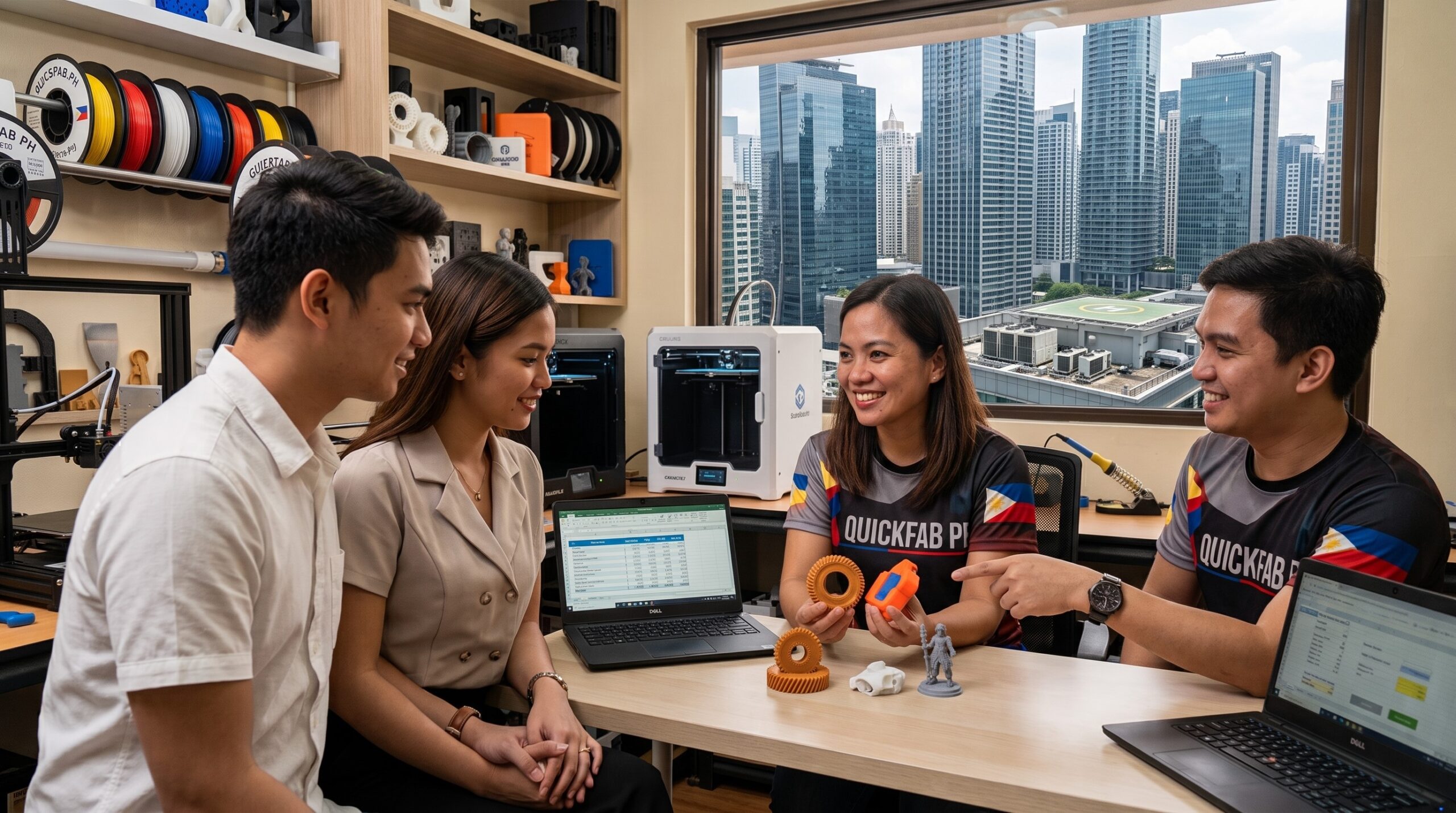
3D printing gives small businesses a practical way to create prototypes, customized products, replacement parts, and tools without relying entirely on traditional manufacturing. For businesses in the Philippines, it can make product development and production more flexible, especially when working with limited budgets or smaller orders.
Instead of investing in expensive molds or large production runs, businesses can test ideas, make design changes, and produce smaller quantities as needed. From startups and product designers to retailers, educators, engineers, and manufacturers, 3D printing can help turn digital designs into physical products.
With the right equipment, materials, and workflow, 3D printing can support small-scale production, product development, and customized manufacturing without requiring a large manufacturing setup.
Related: The Future of 3D Printing in the Philippines: Opportunities & Challenges
Key Takeaways: 3D Printing for Small Businesses in the Philippines
- What can small businesses use it for? Small businesses can use it for product prototyping, customized products, small-batch manufacturing, replacement parts, business tools, and display models.
- How can it help small businesses? It can help businesses test designs faster, make product changes more easily, and produce customized or limited-quantity items.
- What should businesses consider before investing? Businesses should consider their intended application, material requirements, production volume, equipment costs, maintenance, and technical needs.
- Should every business buy a 3D printer? No. Businesses with occasional or specialized needs may benefit more from professional 3D printing services in the Philippines.
- What is the main benefit for Philippine businesses? It gives small businesses a flexible way to develop, customize, and produce certain products without immediately investing in traditional large-scale manufacturing.
On This Page
- What is 3D Printing for Small Businesses?
- Why Should Small Businesses Consider 3D Printing?
- How 3D Printing Can Benefit Philippine Small Businesses
- Practical 3D Printing Applications for Small Businesses
- 3D Printing in the Philippines: Is It Suitable for Every Business?
- What Should Small Businesses Consider Before Investing in a 3D Printer?
- Should a Small Business Buy a 3D Printer or Use a Service?
- Making 3D Printing Work for Small Businesses in the Philippines
- Frequently Asked Questions About 3D Printing for Small Businesses
What is 3D Printing for Small Businesses?
Rather than removing material from a block or shaping it through molds, 3D printing produces objects directly from a digital design. The printer deposits, cures, or fuses material in successive layers until the physical object takes shape, making it an additive manufacturing method.
For small businesses, this can provide greater flexibility during product development and production. Instead of ordering hundreds of units immediately, a business can print a prototype, evaluate it, make adjustments, and produce another version.
This approach is particularly useful when products need frequent design changes or when only a limited number of items are required.
Why Should Small Businesses Consider 3D Printing?
The biggest advantage of 3D printing is flexibility.
Small businesses often operate on tighter budgets and lower volumes than large manufacturers. Purchasing custom molds, managing excess inventory, or outsourcing specialized components can rapidly inflate operational costs.
Some potential benefits include:
- Faster product development
- Lower prototyping costs
- Customization and personalization
- Small-batch production
- Reduced material waste
- On-demand manufacturing
- Faster design iterations
- Easier production of complex shapes
The actual savings and production benefits will depend on the printer, material, design, production volume, and application. Still, the technology can be a practical addition to a small business’s existing workflow.
How 3D Printing Can Benefit Philippine Small Businesses
3D printing gives small businesses in the Philippines greater flexibility throughout product development and production. Businesses can test ideas, make changes, create customized products, and produce certain items in smaller quantities without immediately committing to large-scale manufacturing.
Faster Design Iterations
Faster product development is one of the benefits of using 3D printing. Instead of waiting weeks for a supplier to change a mold, a business can update the CAD file and print a new version within hours. This allows teams to find problems early, make improvements, and test how well a product works before starting full-scale production.
More Flexible Production
Demand can be unpredictable, especially for smaller businesses. Producing large quantities in advance may leave money tied up in inventory, particularly when a product is still new or has several variations.
3D printing offers another option. Certain products, components, or accessories can be produced in smaller quantities and closer to when they are needed. This can be especially useful for businesses that handle custom orders or niche products.
Greater Customization
Customization is another area where 3D printing can give small businesses an advantage. Instead of producing one standard design, businesses can make relatively small changes to create different versions of a product.
For example, a business could offer:
- Personalized names or designs
- Different sizes or shapes
- Custom-fit components
- Limited-edition product variations
This flexibility can make it easier to serve customers looking for something more specific than what is typically available through mass-produced products.
Reduced Prototyping Barriers
Making a new product can be expensive, especially for startups with small budgets. Traditional prototypes may need molds, tools, or large orders, which can cost a lot. With 3D printing, businesses can quickly make a sample, test it, make changes, and print it again. This makes it easier to test an idea before spending money on large-scale production.
Better Design Control
Having access to a 3D printer can give businesses more control over the design and testing process. Teams can make adjustments internally, create prototypes when needed, and evaluate changes without waiting for an outside manufacturer.
This can be especially useful for businesses that frequently modify products or develop customized designs.
Practical 3D Printing Applications for Small Businesses
For small businesses, 3D printing can be useful across product development, production, operations, and marketing. Its value depends on the business and what it needs to create, but several applications stand out as practical starting points.
1. Product Prototyping
Businesses can print a product sample from a digital design before starting full production. This helps them check the product’s size, fit, look, and function. For example, a home goods startup can test a sample, find problems, and make changes before producing many units. This helps save time and avoid costly mistakes.
2. Customized Products
Customization can give small businesses an opportunity to offer products that are more tailored to individual customers. Since digital designs can be modified without creating an entirely new production setup, different versions can be made for specific orders.
Common examples include:
- Personalized home décor and gifts
- Customized organizers
- Product accessories
- Promotional items
- Custom-fit components
- Specialty products
This approach works especially well for businesses serving niche markets where customers are willing to pay for products made to their preferences.
3. Small-Batch Manufacturing
Producing large quantities may not make sense for startups or businesses with limited demand. 3D printing for small-batch manufacturing enables businesses to make smaller quantities without the need for costly tooling.
For example, a startup can produce a small batch, sell it to early customers, and use their feedback to improve the product before scaling up. Small-batch production is especially useful for new businesses, niche products, and products with uncertain demand.
4. Replacement Parts and Business Tools
3D printing can also solve smaller, everyday problems inside a business. Depending on the part’s purpose and material requirements, it can be used to produce certain brackets, covers, holders, clips, jigs, fixtures, and other non-critical components.
A workshop might create a custom fixture to position parts during assembly, while a retail store could make a display holder designed for a specific product. These small improvements can make routine tasks more convenient and help businesses create tools that fit their particular setup.
5. Marketing and Display Models
A physical model can be valuable when a product is difficult to explain through photos or digital renderings alone. Businesses can use 3D printing to create something tangible for presentations, exhibitions, sales meetings, or customer demonstrations.
Examples include:
- Product mockups
- Scale models
- Packaging concepts
- Display pieces
- Demonstration models
- Trade show materials
For startups pitching a new idea or businesses preparing for an event, a physical model can give customers and potential partners a clearer idea of what the finished product will look and feel like.
3D Printing in the Philippines: Is It Suitable for Every Business?
Not necessarily. 3D printing is useful for many applications, but it is not a universal replacement for conventional manufacturing.
The right approach depends on factors such as:
- Production volume
- Required material properties
- Product dimensions
- Desired surface finish
- Required production speed
- Design complexity
- Budget
- Intended use of the finished product
For high-volume production of a simple component, traditional manufacturing may still be more efficient. For customized products, prototypes, complex geometries, or low-volume production, additive manufacturing can be a more attractive option.
Businesses should evaluate the complete production workflow rather than choosing a technology simply because it is new.
What Should Small Businesses Consider Before Investing in a 3D Printer?
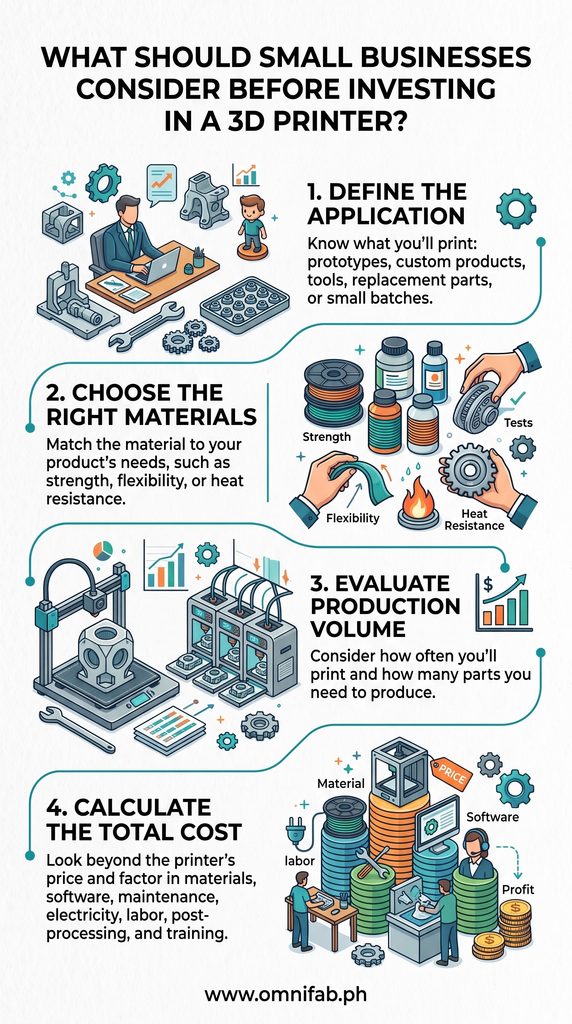
Buying a printer is only one part of setting up a successful 3D printing workflow.
Define the Intended Application
Before choosing a 3D printer, think about what the business actually needs it to do. Will it mainly be used for prototypes, customized products, replacement parts, tools, or small-batch production? Having a clear use case makes it easier to narrow down the right printer type, build volume, resolution, and other specifications. There is little value in paying for features that the business will rarely use.
Consider Materials
The material should match the job. A business creating basic visual prototypes may only need standard thermoplastics like PLA or PETG, while projects requiring flexible, impact-resistant, or heat-resistant components may call for specialized materials like ABS, Nylon, or TPU. Instead of choosing a material based solely on price, consider how the finished part will be used and the environmental conditions it needs to withstand.
Evaluate Production Volume
Think about how often the printer will actually be running. A business that only needs a few prototypes each month will have different requirements from one producing dozens of parts every week. Estimating the expected workload can help determine the right printer capacity and prevent businesses from investing in equipment that is either too limited or more advanced than necessary.
Factor in the Complete Cost
Beyond the machine’s initial price tag, operating an in-house 3D printer involves several ongoing expenses:
- Printing materials
- Software
- Maintenance and replacement parts
- Electricity
- Labor and operator time
- Post-processing
- Training
Looking at these expenses together gives a clearer idea of what it will actually cost to operate the printer. It also makes it easier to compare the cost of printing in-house with using professional 3D printing services in the Philippines.
Should a Small Business Buy a 3D Printer or Use a Service?
Having a 3D printer on-site can be useful for companies that regularly create prototypes or custom parts. Businesses with occasional projects, however, may find outsourcing more practical than managing their own equipment and maintenance.
Outsourcing can also give businesses access to different printing technologies, materials, and professional expertise without buying multiple machines. The best option depends on the company’s production needs, budget, technical skills, and how often it plans to use 3D printing.
Making 3D Printing Work for Small Businesses in the Philippines
For small businesses, 3D printing offers a practical way to turn ideas into products, test designs, create customized items, and manage smaller production runs.
When exploring this option in the Philippines, start with a clear use case and consider the required materials, production volume, and overall costs. Depending on the project, investing in equipment or working with a professional service provider may make more sense.
With the right approach, this technology can support product development, customization, and innovation without requiring a large manufacturing setup from the start.
Frequently Asked Questions About 3D Printing for Small Businesses
How can small businesses use 3D printing?
Small businesses use 3D printing for rapid prototyping, custom product manufacturing, low-volume production runs, functional replacement parts, and promotional display models. It allows teams to create finished goods directly from digital CAD files without tooling.
Is 3D printing profitable for small businesses?
3D printing can be profitable for some small businesses, particularly those selling customized products, niche items, or low-volume products. Profitability depends on material costs, equipment, labor, production volume, pricing, and customer demand.
What are the main benefits of 3D printing for small businesses?
The main benefits include faster product development, flexible production quantities, lower prototyping costs, customization, and easier design changes. Businesses can also produce certain items on demand, which may help reduce the need for excess inventory.
Can 3D printing replace traditional manufacturing?
No. Traditional manufacturing can remain more efficient for many high-volume products, particularly when producing thousands of identical parts. 3D printing is often better suited to prototypes, customized products, complex geometries, and low-volume production.
Related: 3D Printing vs. Traditional Manufacturing: What’s Their Difference?
Is 3D printing a good option for startups in the Philippines?
3D printing can be a practical option for Philippine startups developing prototypes, customized products, or limited production runs. Startups should compare the cost of owning equipment with outsourcing before investing in a printer.
How much does 3D printing cost in the Philippines?
In the Philippines, 3D printers typically cost ₱8,000–₱50,000, while professional or industrial models can cost ₱100,000 or more. PLA and PETG generally cost around ₱500–₱1,500 per kilogram, while outsourced FDM printing can cost about ₱5–₱15 per gram.
Get reliable 3D printing services for small businesses in the Philippines and bring your ideas to life. Contact us today!