


Blog
Best Materials Used in Pellet 3D Printing and Applications

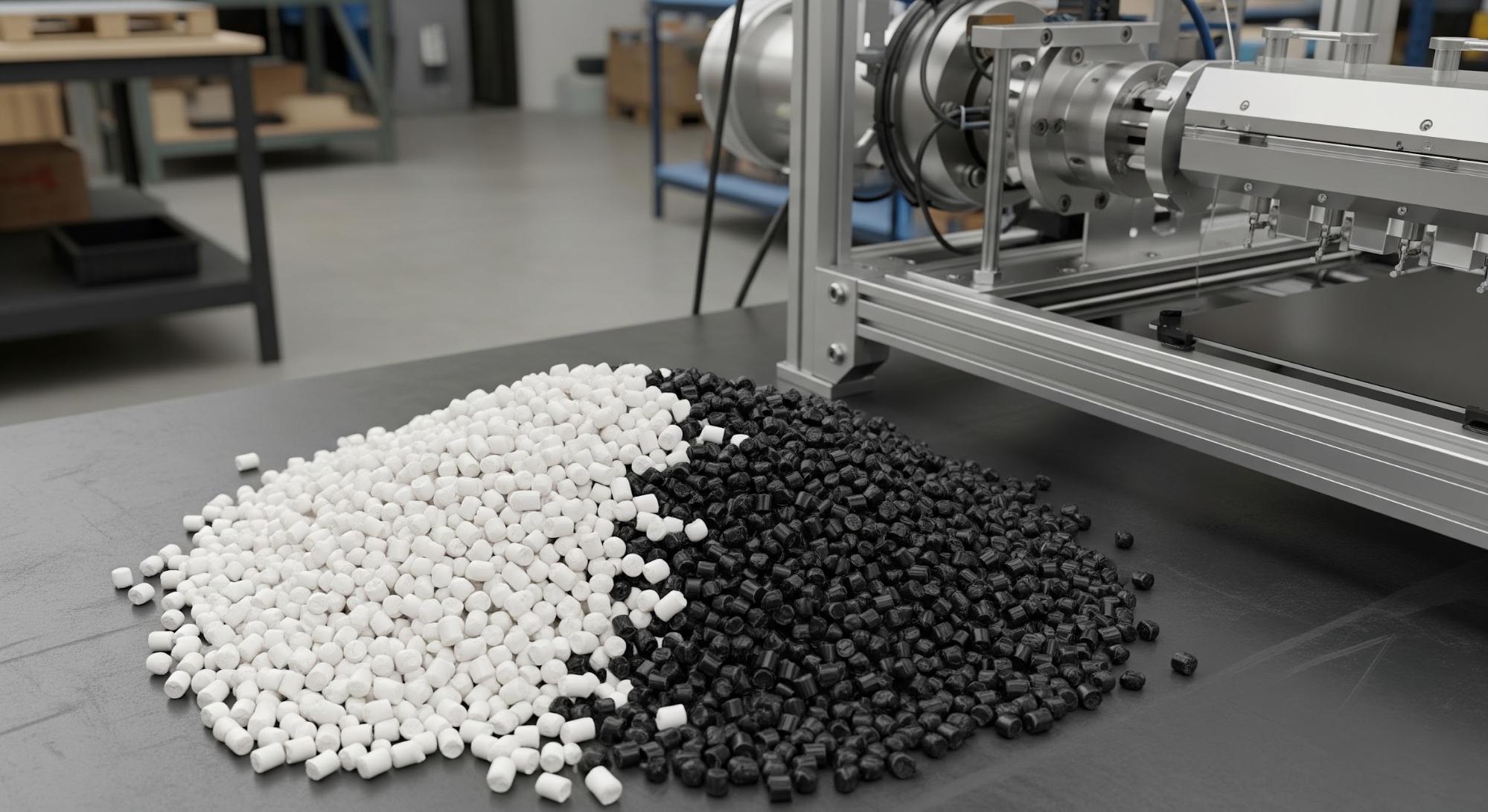
Pellet 3D printing is becoming more popular in large-scale and industrial manufacturing. Instead of using plastic filament spools, this method uses small plastic pellets, which are the same raw materials used in injection molding. Because of this, it is often more affordable and better suited for bigger projects.
If you’re looking into pellet 3D printing materials for production, prototyping, or research, choosing the right one is important. The material you select affects how strong, flexible, smooth, or cost-efficient your final product will be.
In this guide, we’ll go through the best materials used in pellet 3D printing, where they are commonly applied, and how to choose the right option for your needs.
On This Page
- What Makes Pellet 3D Printing Different?
- Pellet 3D Printing vs. 3D Printing Filament: What’s the Difference?
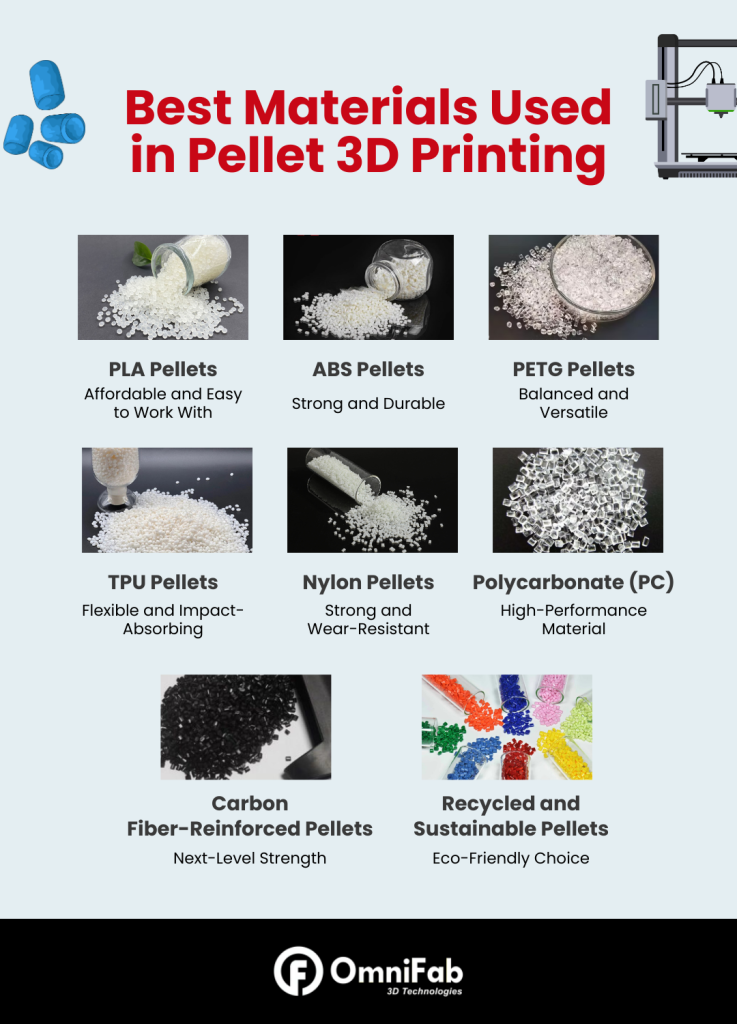
- PLA Pellets: Affordable and Easy to Work With
- ABS Pellets: Strong and Durable
- PETG Pellets: Balanced and Versatile
- TPU Pellets: Flexible and Impact-Absorbing
- Nylon Pellets: Strong and Wear-Resistant
- Polycarbonate (PC): High-Performance Material
- Carbon Fiber-Reinforced Pellets: Next-Level Strength
- Recycled and Sustainable Pellets: Eco-Friendly Choice
- Common Pellet 3D Printing Applications
- Choosing the Right Material for Your Project
- Final Thoughts on Pellet 3D Printing Materials and Applications
What Makes Pellet 3D Printing Different?
Unlike traditional filament-based systems, pellet extrusion feeds raw thermoplastic pellets directly into the extruder. If you’re new to the technology, you can first understand what a pellet 3D printer is, and how it works in industrial settings. These pellets are the same materials commonly used in injection molding.
This setup allows for:
- Lower material cost
- Faster material deposition
- Large-format builds
- Access to engineering-grade polymers
- Easier integration of recycled plastics
Because of these advantages, industrial pellet 3D printing materials are widely used in manufacturing, automotive, furniture, and construction industries.
But how does it compare to the more common filament system?
Pellet 3D Printing vs. 3D Printing Filament: What’s the Difference?
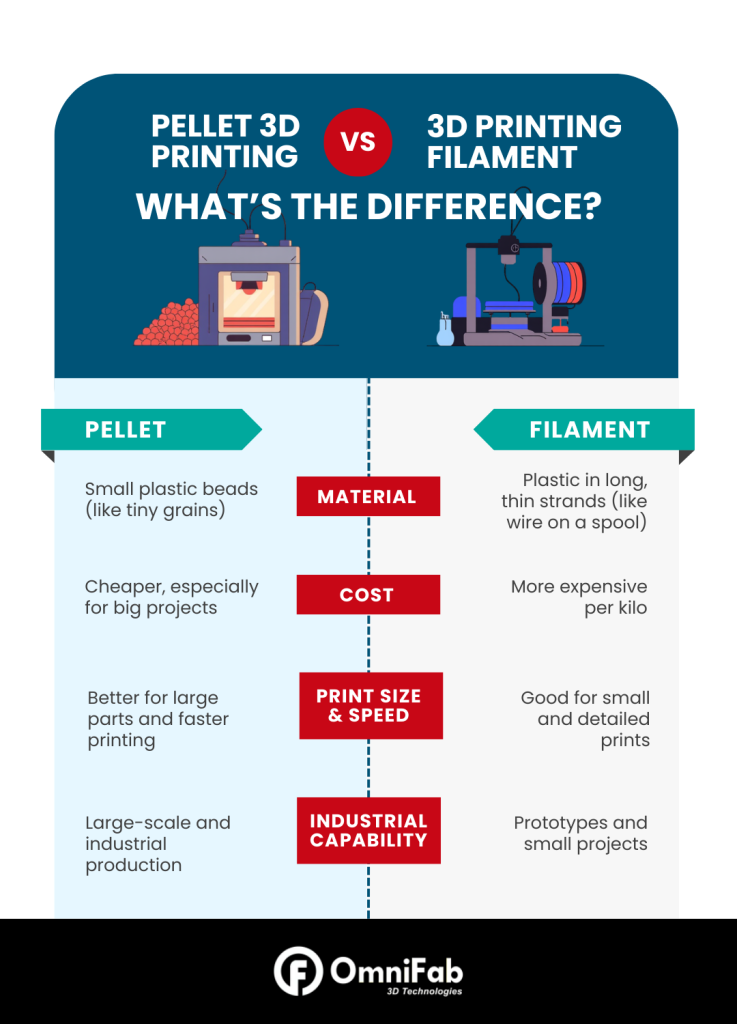
At first glance, both technologies may seem similar. However, the differences become clearer when you compare scale, cost, and intended use.
1. Material Format
Filament printers rely on pre-spooled plastic strands. In contrast, pellet-based systems use raw thermoplastic granules—the same form commonly used in injection molding.
Related: What is a 3D Printing Filament? A Beginner’s Guide
Because granules require less processing, they are typically more affordable. This cost advantage makes them a practical option for large-scale production.
2. Cost Efficiency
Filament is convenient and widely accessible, especially for small projects or detailed prototypes. However, it generally costs more per kilogram.
Pellets are more economical when purchased in bulk, which is why many manufacturers use them for continuous or high-volume production.
3. Print Size and Speed
Filament machines are ideal for desktop or mid-sized builds. They’re commonly used for small components and precise models.
Pellet extrusion systems, on the other hand, are built for larger formats and higher deposition rates. As a result, they’re often used for furniture, molds, tooling, and structural parts in industrial environments.
4. Industrial Capability
Filament printing works well for prototyping and design validation.
Pellet-based systems support engineering-grade plastics and reinforced composites, making them better suited for manufacturing settings that demand strength and durability.
For companies in the Philippines exploring large-scale additive manufacturing, the appeal often lies in scalability and long-term material savings.
Now that the distinction is clearer, let’s take a closer look at the most commonly used materials.
PLA Pellets: Affordable and Easy to Work With
Best for: Prototyping, molds, display parts, educational projects
PLA (Polylactic Acid) remains one of the most popular thermoplastic pellets for 3D printing, especially for low-stress applications.
Why choose PLA?
- Easy to print
- Minimal warping
- Good surface quality
- Biodegradable options available
PLA is ideal for visual prototypes and demonstration models. However, it isn’t the best option for high-heat or heavy-load environments.
If you’re starting out with pellet 3D printing materials, PLA is often the most beginner-friendly choice.
ABS Pellets: Strong and Durable
Best for: Functional parts, housings, automotive components
ABS (Acrylonitrile Butadiene Styrene) is one of the most reliable industrial pellet 3D printing materials due to its durability and impact resistance.
Why ABS works well:
- Tough and impact-resistant
- Heat-resistant compared to PLA
- Suitable for post-processing
- Widely available
Because of its strength, ABS is commonly used in pellet 3D printing applications in manufacturing, particularly for functional prototypes and end-use parts.
Proper temperature control is important, as this material can warp if cooling is uneven. Fortunately, most industrial systems are designed to handle this.
PETG Pellets: Balanced and Versatile
Best for: Mechanical parts, protective covers, consumer products
PETG combines the best qualities of PLA and ABS. It’s durable but easier to print than ABS.
Advantages:
- Strong layer adhesion
- Chemical resistance
- Low shrinkage
- Food-safe options available
Many manufacturers consider PETG one of the best materials for pellet 3D printing when versatility is required. It performs well across different industries and doesn’t require overly complex printing conditions.
TPU Pellets: Flexible and Impact-Absorbing
Best for: Seals, gaskets, footwear components, soft-touch parts
TPU (Thermoplastic Polyurethane) introduces flexibility into the equation. Instead of rigid parts, you get elasticity and impact resistance.
Why choose TPU?
- High flexibility
- Abrasion resistance
- Shock absorption
- Durable under repeated stress
Flexible materials like TPU expand the range of pellet 3D printing applications, especially in product design and industrial components where movement or vibration is involved.
Nylon Pellets: Strong and Wear-Resistant
Best for: Gears, mechanical parts, load-bearing components
Nylon is known for its toughness and durability. It handles friction and mechanical stress better than many other polymers.
Benefits:
- Excellent strength-to-weight ratio
- High wear resistance
- Good chemical resistance
- Suitable for functional parts
For companies involved in heavy manufacturing, Nylon is often included in their lineup of industrial pellet 3D printing materials. However, it absorbs moisture easily, so proper storage and drying are essential.
Polycarbonate (PC): High-Performance Material
Best for: Industrial tooling, high-heat parts, structural components
Polycarbonate is one of the strongest thermoplastics available for pellet extrusion systems.
Why it’s powerful:
- High impact resistance
- Excellent heat resistance
- Transparent options available
- Suitable for demanding environments
PC is commonly used in large-scale pellet 3D printing applications where performance matters more than cost.
Carbon Fiber-Reinforced Pellets: Next-Level Strength
Best for: Structural parts, automotive tooling, aerospace components
When extra rigidity is needed, carbon fiber-reinforced polymers are a strong choice. These composite materials improve stiffness without significantly increasing weight.
Advantages:
- High strength-to-weight ratio
- Reduced warping
- Increased dimensional stability
- Professional-grade performance
These materials are increasingly used in advanced industrial pellet 3D printing materials for manufacturing, especially in sectors that demand durability and precision.
Recycled and Sustainable Pellets: Eco-Friendly Choice
Sustainability is becoming a major focus in additive manufacturing. One advantage of pellet extrusion systems is that recycled plastics can often be processed directly.
Benefits of recycled pellets:
- Reduced material cost
- Lower environmental impact
- Supports circular manufacturing
This makes pellet extrusion particularly attractive for pellet 3D printing in the Philippines, where sustainable production initiatives are steadily growing across industries.
Common Pellet 3D Printing Applications
The type of material you choose depends heavily on the intended use. Here are some common pellet 3D printing applications across industries:
1. Automotive Manufacturing
Used for dashboards, interior panels, tooling fixtures, and structural prototypes.
2. Furniture Production
Large-format systems can print chairs, tables, and decorative elements using durable thermoplastics.
3. Construction and Architecture
Formworks, molds, and customized structural components can be produced efficiently.
4. Industrial Tooling
Factories often print jigs, fixtures, and custom production tools.
5. Product Development
Startups and manufacturers use pellet extrusion for rapid prototyping of large components. Because pellet systems support bulk material feeding, they’re especially suitable for large-format 3D printing services for industrial applications.
Choosing the Right Material for Your Project
With several pellet 3D printing materials available, narrowing down the best option can feel overwhelming. Instead of guessing, it helps to evaluate your project from a practical standpoint.
Here’s a simpler way to think about it:
1. Start with Performance
Ask yourself what the part actually needs to do.
Will it carry weight? Handle impact? Bend without breaking?
If strength and rigidity matter, materials like Nylon or carbon fiber-reinforced pellets may be ideal. For flexibility, TPU might be the better fit. Matching the material to the function should always come first.
2. Think About the Environment
Next, consider where the part will be used.
Will it sit outdoors under the sun? Be exposed to heat? Come into contact with oils or chemicals?
Some plastics perform well in controlled indoor settings but degrade quickly in harsh environments. Heat-resistant options like Polycarbonate or durable choices like ABS are often better suited for demanding conditions.
3. Review Your Budget
Pellet extrusion is generally more cost-efficient than filament-based systems, especially for large builds. Still, material pricing varies. Engineering-grade polymers and reinforced composites naturally cost more than standard PLA or PETG.
Balancing performance and cost is key—especially in production settings.
4. Consider Production Volume
If you’re printing large-format components or running multiple builds, material efficiency becomes even more important. Bulk pellets make scaling easier, which is why many manufacturers prefer industrial pellet 3D printing materials for long-term use.
Final Thoughts on Pellet 3D Printing Materials and Applications
Pellet extrusion technology makes additive manufacturing more affordable, scalable, and ready for industrial use. From PLA and ABS to carbon fiber-reinforced polymers, there are plenty of options when deciding which materials work best for your project.
Each polymer serves a different purpose. Some prioritize cost efficiency and ease of processing, while others are built for strength and high-performance environments. The key is understanding what your application requires before making a choice.
As adoption continues to grow, pellet-based systems will play an even bigger role in large-format and industrial production, both locally and globally.
Take your production to the next level. Get a quote for a pellet 3D printer in the Philippines or contact us to start your project today.